
Ford Transit vs. Mercedes Sprinter: The Data Behind Our Choice (Updated 2026)

Here’s something you may not know about us: we’re total nerds when it comes to data-driven decisions.
When we were deciding which chassis to build Paradigm around, we didn’t just follow what was popular.
And the deeper we looked, the more convinced we became that the Ford Transit was the platform we wanted to build on.
In this article, we dig into some of the numbers that rarely make it into the Transit-vs.-Sprinter conversation: U.S. sales volume, owner complaints normalized for those sales, fuel cost per mile, service-network coverage, engine performance, and even the wall-cavity depth available for insulation. Taken together, they paint a surprisingly different picture of the two platforms—and helped explain why we chose the Ford Transit.
The Mercedes Sprinter has long felt like the default campervan platform, and for good reason: it had a head start. By the time Ford introduced the high-roof Transit in the U.S. for the 2015 model year, the Sprinter was already well established, and an entire campervan industry had grown around it.
That history still shapes what many people picture when they hear “campervan.” But history wasn’t the question we cared about.
We wanted to ask something more useful:
Which van would we actually rather own?
Because everything we talk about when designing a Paradigm van, simplicity, serviceability, durability and spending less time managing the van, starts with the vehicle underneath the camper.
So, let’s begin with the engine.
42% more horsepower. 20% more torque.
The Transit EcoBoost produces 300 horsepower and 400 lb-ft of torque. The high-output Sprinter diesel produces 211 horsepower and 332 lb-ft.
That difference shows up once you add the weight of a complete camper and start climbing mountain passes, merging onto the interstate, passing at elevation, or pulling a trailer.
Comparing two of the closest camper-ready configurations, a 148-inch High Roof AWD Transit with the EcoBoost and a 144-inch High Roof AWD Sprinter with the high-output diesel, the Sprinter carries an MSRP roughly $6,600 higher.
In summary, the Transit costs less, starting out roughly $6,600 lower while also delivering substantially more engine-power.
Next: Fuel Costs
Sprinter diesel generally uses fewer gallons per mile, but diesel typically costs more than regular gasoline. What matters to your wallet is cost per mile, not MPG alone.
Better MPG doesn’t automatically mean cheaper fuel costs.
Depending on the gas-diesel price spread, the Sprinter’s fuel-economy advantage can shrink considerably or disappear.
The purchase price isn't the end of the cost difference
A modern diesel brings more systems with it: DEF, diesel particulate filtration, regeneration, and the associated emissions hardware and sensors. A gasoline Transit doesn’t have them.
That doesn’t mean every Sprinter will have problems. It does mean there are additional diesel-specific components to maintain, diagnose, and potentially repair.
For 2026, Mercedes prices its complete 5-year/100,000-mile Sprinter coverage and five-service package at approximately $12,300.
A comparable 5-year/100,000-mile combination of Ford protection and prepaid maintenance for the Transit is approximately $5,625.
That’s a difference of about $6,675, making the comparable Sprinter package approximately 119% more expensive.
Historical repair and maintenance data points the same direction.
RepairPal estimates average annual repair and maintenance costs of approximately $947 for the Ford Transit 250 compared with $1,778 for the Mercedes-Benz Sprinter 2500.
That’s about $831 more per year, or an 88% difference, in RepairPal’s historical data.
Those figures aren’t a prediction of what every individual van will cost. They do reinforce the broader point: the Sprinter costs more to buy, and the available data points toward higher costs to keep it on the road.
The market has changed, and today’s sales tell that story.
By 2025, more than four Ford Transits were sold in the United States for every Mercedes Sprinter.
Ford sold approximately 132,000 Transits in 2020, 100,000 in 2021, 99,000 in 2022, 129,000 in 2023, 153,000 in 2024 and nearly 162,000 in 2025.
Sprinter sales over those same years remained far lower, generally ranging from roughly 38,000 to 47,000 annually.
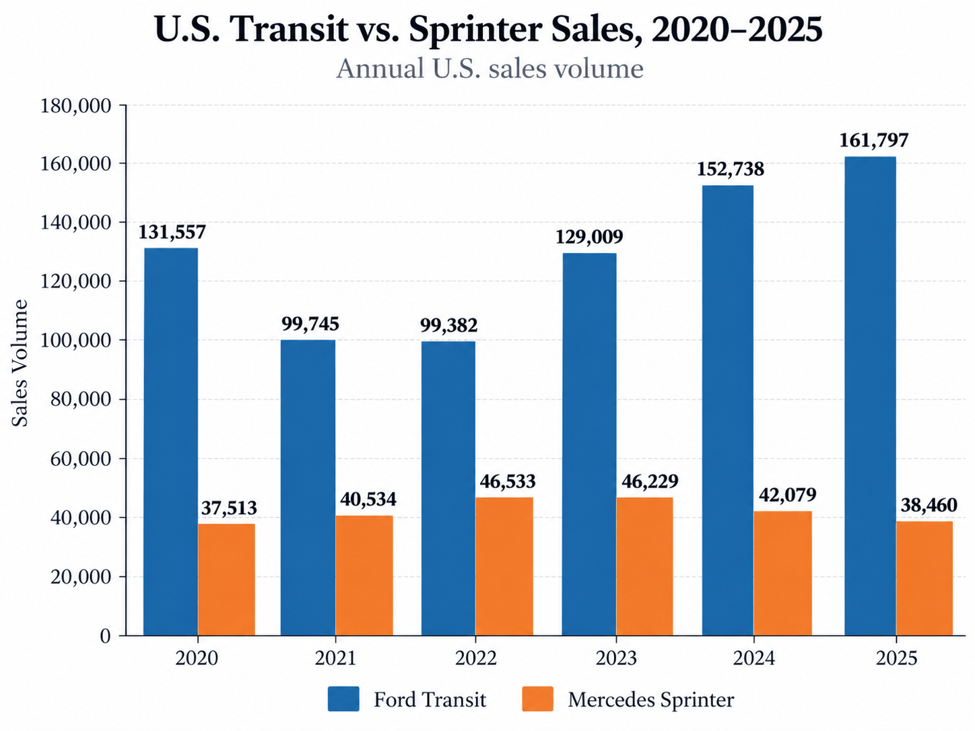
Sales volume by itself doesn’t make one platform better. But scale matters to the ecosystem around a vehicle: parts demand, technician familiarity, independent repair capability, and dealer infrastructure.
Sales volume also gives important context to reported problems.
In 2024, for example, Ford sold more than 3.6 Transits for every Sprinter, yet the Sprinter still exceeded the Transit in total NHTSA owner complaints.
Normalized against U.S. sales volume, the difference becomes much larger.
For the 2024 model year, that works out to approximately 8.8 complaints per 10,000 Sprinters versus 1.8 complaints per 10,000 Transits.
Looking across 2020 through 2025 shows the broader pattern.
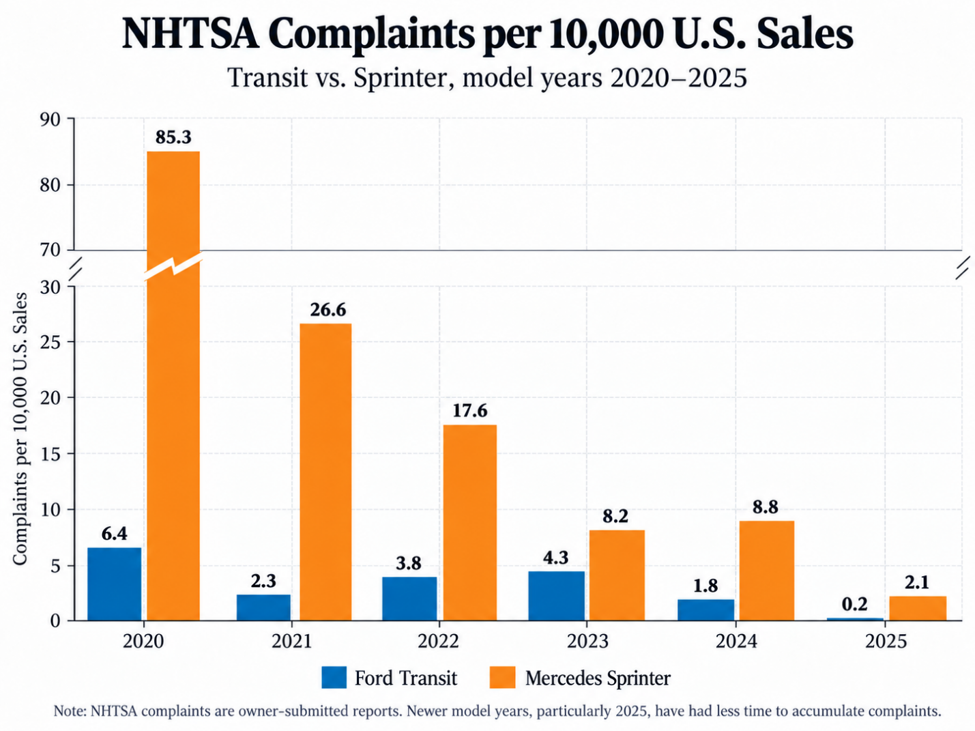
Note: NHTSA complaints are owner-submitted reports. These figures normalize complaint counts against same-year U.S. sales; they are not a controlled failure-rate study. Newer model years, particularly 2025, have also had less time to accumulate complaints.
We don’t treat that as proof that every Sprinter will have problems or every Transit will be trouble-free.
But it does challenge the idea that Sprinter complaints only seem more common because more Sprinters are on the road. In the U.S., the opposite is true: substantially more Transits are sold.
When something does break, where can you get it fixed?
For us, reliability isn’t only about whether something breaks. It’s also about what happens when it does, and that is where the service network becomes difficult to ignore.
Nearly a 10-to-1 difference in U.S. locations.
Current location data identifies roughly 2,800 Ford dealerships across the United States, compared with fewer than 300 Mercedes-Benz Vans locations.


Ford also has more than 700 dedicated Commercial Vehicle Centers specifically equipped around commercial vehicles like the Transit.
And the options don’t necessarily end at a Ford dealership. Independent shops routinely service Ford vehicles, and Ford’s Professional Service Network gives participating facilities access to Ford-backed parts, diagnostic tools, technical resources, and training.
Having routine maintenance performed by a qualified independent shop does not, by itself, void the vehicle’s factory warranty. Warranty-covered repairs still go through the manufacturer, but owners have considerably more options for routine service and many out-of-warranty repairs.
That matters when your camper is also your transportation, hotel, and way home. A service network is easy to ignore while shopping; it becomes more important when you’re 1,000 miles from home and need to keep moving.
Then there’s what we see as builders
Some Transit advantages become apparent only after you begin converting it into a camper.
67% more wall-cavity depth
The Transit provides approximately 4.5 inches of wall-cavity depth, compared with about 2.7 inches in the Sprinter - roughly 67% more space available for insulation.
We make full use of that space.
Rather than installing a single layer of insulation and stopping there, we fill the available wall cavity to its practical depth wherever the structure allows it, regardless of which platform we are working on.
That matters in a four-season camper.
Two finished vans can look almost identical inside while hiding very different amounts of insulation. The Transit’s additional cavity depth gives us more room to build the thermal envelope we want without sacrificing interior space to create that depth ourselves.
Ford gives us better places to run things
Ford also gives upfitters useful pathways and pass-through locations for routing electrical wiring through the body structure.
That sounds like a small construction detail until you’re the one building the van, or per say, you would like to add something later down the road.
Every time an upfitter creates a new penetration through the vehicle body, that opening has to be properly treated and sealed to protect against moisture and corrosion.
Designing around Ford’s existing pathways lets us avoid many unnecessary penetrations altogether. The bigger benefit isn’t just labor; it’s consistency.
We’re using provisions designed into the vehicle rather than inventing a new solution each time.
The more the chassis gives us to work with from the beginning, the less we have to modify, compensate for or work around later.
More room where it matters
The Transit High Roof also starts with more vertical space: Ford publishes 81.5 inches of maximum cargo height, while Mercedes publishes approximately 77 inches of interior standing height for comparable high-roof Sprinter configurations.
A few inches may not sound dramatic on a specification sheet.
Inside a campervan, they matter.
Some height is inevitably lost to insulation, flooring, and ceiling materials, so starting with more gives us flexibility: standing room, insulation, garage clearance, space above the mattress, cabinetry, or some combination.
Both platforms offer AWD.
Both can be very capable in snow and on the forest roads and rough pavement that often come with getting outside.
Cold weather matters differently in a camper
In winter, a campervan isn’t just a vehicle; it’s the place you’re depending on to keep you warm overnight.
At sufficiently low temperatures, diesel fuel can begin to wax or gel and restrict fuel flow. Winterized diesel and the Sprinter’s factory fuel-preheating system help address this, but cold-weather fuel management remains something a diesel owner needs to understand.
In a camper, that fuel can be doing two jobs: a diesel-fired cabin heater drawing from the vehicle tank depends on that same diesel fuel.
Our Transit-based campers use gasoline-fired heat supplied from the vehicle’s fuel tank. Gasoline doesn’t have the same paraffin-gelling problem, eliminating that particular cold-weather variable from both the vehicle and the cabin heating system.
Paradigm vans are four-season campers designed to take people into the mountains in winter, not just live in the city.
In winter mountain environments, eliminating another thing the owner needs to manage has real value.
And sometimes it’s the little things
Some differences only become obvious after you live with the van, not just shopping for one. The rear doors are a good example.
The Transit rear doors have positive hold-open positions that keep the doors predictably in place while you’re loading gear or working at the back of the van. They can then be released to swing farther around the side when additional access is needed.
That sounds like an obvious feature until you’ve dealt with rear doors that don’t stay where you put them.
Sprinter owners have complained about rear doors moving or slamming in windy conditions or when the van is parked on an incline, and an aftermarket industry has developed straps, struts and other door-control solutions intended to keep them in position.
No one chooses a campervan because of a door hinge. But details like this add up, shaping whether living with the vehicle feels effortless or whether you keep adding another accessory, modification, or workaround.
Where the Sprinter can make sense
The Sprinter does offer real advantages.
If maximum interior length and volume are the overriding priorities, the Sprinter 170 Extended is exceptionally long and Ford has no direct equivalent. For a limo-style or maximum-volume build, that can make the Sprinter a better fit.
The Sprinter also has a mature campervan aftermarket, with a large accessory ecosystem built around its long history whereas the Transit aftermarket is still expanding.
But those aren’t the priorities that drove our decision.
So why Transit?
When we step back, the pattern is remarkably consistent.
More performance for less initial cost.
Lower available maintenance and protection-plan costs, with a simpler gasoline powertrain.
Far greater U.S. sales volume and lower normalized NHTSA complaint rates in the years we examined.
A dramatically larger domestic service network.
More usable wall depth, integrated upfitter provisions, and high-roof interior height.
Factory AWD with fewer cold-weather fuel variables for the owner.
Those advantages exist before we install a single piece of the camper.
We aren’t choosing a chassis for the first day someone owns the van.
We’re thinking about year five.
Year ten.
The road trip thousands of miles from home.
The cold morning in the mountains.
The eventual repair that every vehicle will someday need.
The same philosophy we apply inside the van applies underneath it:
Make it capable. Keep it straightforward. Make it serviceable. And design it to be easy to live with for a long time.
That’s why the Voyager and Longhorn start with a Ford Transit.
We don’t share any of this to beat up on the Sprinter. It has earned its place in the campervan world, and for some applications it may still be the right platform.
But when we step back and look objectively at the things that matter most to long-term ownership, the data points consistently in the Transit’s favor.
And in some ways, that’s really what this article is about.
We are relentlessly committed to building the best van we know how to build.
That means questioning assumptions, digging into the data, living with the details, and being willing to make a different choice when we believe there is a better one.
It’s also why we don’t build custom one-offs. Our goal is to take a carefully chosen platform and a carefully developed set of systems, then pore over every detail until the entire van works together the way we believe it should.
Hopefully this comparison gives you a small glimpse into the amount of thought and care that goes into the decisions behind a Paradigm van, long before we ever start building yours.
If this sounds like the ownership experience you want, take a closer look at the Voyager and Longhorn—or get in touch and let’s talk.


Comments